Showing posts with label Vietnam. Show all posts

Friday, September 9, 2016

Halong Bay: Cruising in a Painting


text and some photos by Ino Manalo


view of Halong bay from the movie, Indochine


Shots from Indochine
                                                                                          
                                                                                
There is a scene from a famous film where a couple evades the turmoil of their country by taking a boat trip through a fascinating archipelago. For countless hours, the lovers lie ensconced in their vessel as it glides past a fairyland of forest-covered peaks rising from the sea.

The fantastic setting for this unforgettable episode is actually Halong Bay in the northern Vietnamese province of Quang Ninh, an easy two to three hour ride from Hanoi. We arranged our cruise through our hotel in the capital. Since we had the good fortune of staying in an Inter-Continental, I expected that every detail of this marine experience would be carefully organized. It turns out that no one had looked into the matter of rest stops. The establishment where our driver chose to break our journey was not the most pleasant. It had a wooden shed in the backyard which served as the toilet! One would think that surely the folks at the Inter-Continental in Hanoi would be more meticulous about the itineraries of the tour packages which they offered their guests.

The pier where we boarded our boat was not much better. It was crowded, hot, and chaotic. I had no choice but to shrug this off – what else would a busy tropical port be like? Entering our boat, I caught a glimpse of a faint line of irregular forms, hovering on the faraway horizon. They would turn out to be the fabled isles that I had seen in the film.


As we drew closer, I began to see what had attracted so many others before me. I don’t know exactly what it is about this view of countless islands in all shapes and sizes which is so captivating.  In fact, the scenery was truly bewitching. Perhaps it is because the islands stand at different distances so that some are rendered darker or clearer while others are only blurred silhouettes. Chinese artworks come to mind with their varying areas of bold brush strokes and soft washes. Is part of the appeal the sense that one is lost in painting?
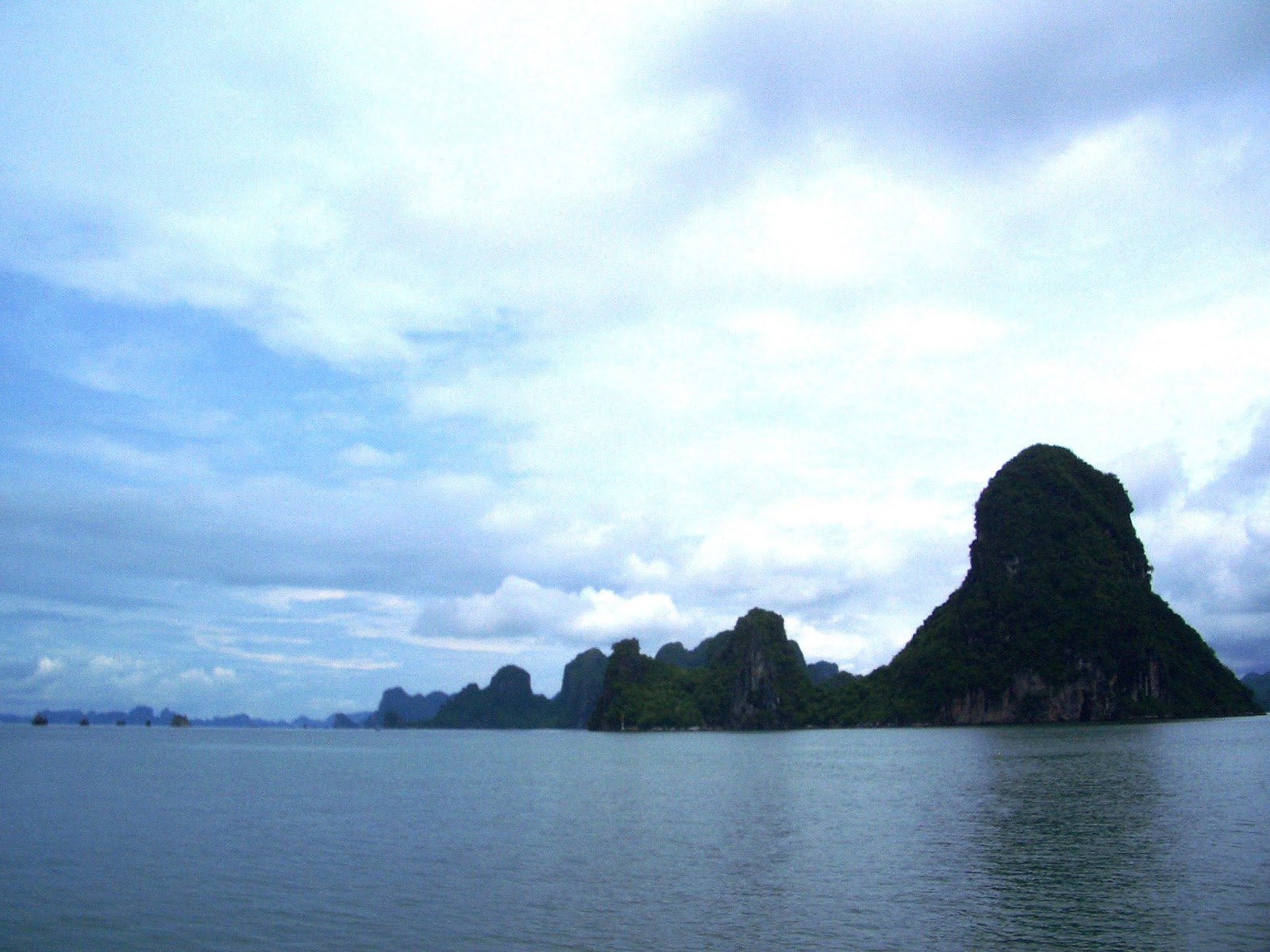


In the case of Halong, the experience is heightened by the fact that we were surrounded by a wide, dark sea. Every curve of peak is doubled, mirrored in a magical realm which appears or disappears according to the whims of the light.

The whole area – about 400 square kilometers – has been inscribed on the UNESCO World Heritage List. The inscription made special mention of the rich biodiversity with about a 1000 species of fish as well as a range of mammals, reptiles, and birds. The islands make up what is referred to as a karst landscape. Into this category falls the terrain of places like Guilin in Southern China or even our very own Chocolate Hills in Bohol. To be precise, Halong is more correctly described as a drowned karst landscape because of its marine setting. In this way it may be compared with Phang Nga in Thailand or El Nido in Palawan.

There are about 1,600 islands in the Bay most of which are uninhabitable because of the steepness of their slopes. We sailed past these emerald mounds anchored in celadon waters for what seemed like hours. Some of the mounds looked like immense stallions grazing in a field of grass. Others looked like castles with half-ruined turrets overgrown by vines. Still others reminded me of the vista from Camp Lookout in the hills behind Dumaguete. There a friend had observed that the clouds were pretending to be islands.


In Halong, time takes a nap on a chair on the deck. No one really talks. The mind is stilled.


Then the captain stopped the engines, suggesting a swim. Only my niece, Mia, took up his invitation. She dove into the sea  -  a plain of viridian glass. I had not quite noticed  -  so enveloped was I by the quiet -  that the sea had become completely flat. There were no waves. The islands had formed a wall that kept the winds and the rest of the world away. We were in a pond. Now that I look back, I wish that I had just jumped in myself. It would have been bliss. Where else can we come upon a pool in the middle of the ocean?


Our boat was a modest affair. There were no cabins – just a large hall that functioned as a dining room. The meal that was served was not fancy. There was fried fish, green sprouts quickly sautéed in garlic, something that was certainly a lumpia, boiled shrimps. We wiped our plates clean.  The freshness and the proximity of the sea made everything so sweet.


A friend who is a travel expert tells me that one can book more elaborate vessels. I have seen pictures of boats which boast of bedrooms that have canopies, carpets, and mood lighting. Some voyages offer well-trained chefs as well as butlers at one’s beck and call. I suppose this can be charming too. Yet how much more pampering does one need when there is this view? I imagine that the scenery will reveal itself just as languorously if one is sitting in plush quarters as when one is in a more spartan chamber.  

At one point, we stopped to visit a floating fish stall. We alighted onto a large wooden platform adrift on the Bay. There were several pens which were really just square openings that revealed nets set in the warm waters. The pens were brimming with sea-life, squirming and splashing about.  It seemed a pity to think that someone could actually point to any of these denizens of the deep and the poor creature would be caught, thrown into a pot and then readied for a fine meal. For a few moments I toyed with the idea of paying the fishermen to let their wards all go. Surely such an act would earn me a place in heaven.


Later on we docked to see a cave. We had to climb a steep path that led up the slopes to enter into the darkness which was actually not so dark. Colored lights had been installed. The caverns looked like a Las Vegas set. Stalagmites became Christmas trees and stalactites became chandeliers. Perhaps entertainers dressed as mermaids and mermen would appear at any minute. We fled back to our boat only to be greeted by a dolphin in the middle of the mountain path, its steel mouth ready to receive our offerings of trash before we were allowed to pass.


As we pulled out of the harbor I spied a huge sign – it was the emblem of the UNESCO World Heritage List. It saddened me when I thought about how it would have been better if Halong Bay’s inscription on this prestigious list were celebrated not with such a prominent marker but with the pristine quality of the environment. When one is presented with so much natural beauty, why is there a compulsion to add another metal dolphin, another cement bench in the shape of a log?

I suppose one should still be thankful. After all, the islands were not covered with billboards. The dolphin cans kept the trails free from trash and the caverns had their own bizarre charm. What’s a little neon light when one can take refuge in such sublime scenery?

During our return trip, our crew brought out some souvenirs to sell. I was actually interested in the way that our whole journey had been choreographed. Clearly, someone had studied the schedule carefully and worked out what should make up the standard trip. There was the moist towel offered when you entered the boat, then the initial cruise, stops at the fish stall and the cave, and the pause for a dip followed by a simple but delicious lunch. At the end came the time for souvenirs.


 I saw fans and pearls, lace doilies and t-shirts. The products were well-fashioned. I noted a wide selection of art works. A number portrayed the Bay. I had thought to myself: should I complete the circle and return from my cruise in the heart of a painting with an actual painting in hand?

I looked at the seascapes which were swirling by. I smiled at the seller and then put away my wallet.  I decided that I would just have to make do with the Halong Bay shimmering in my memory.


Friday, December 23, 2011

Hue


For all they project of being eternal and monumental, cities are malleable like clay. Their edifices and districts are easily molded in accordance with the desires of their builders.

Spanish Manila reflected the conquistadores’ fear of insurrection and contagion. The massive city walls were supposed to preserve Hispanic security as well as an illusory purity of blood. In contrast, America’s draconian military might established broad boulevards and Neo Classical government palaces outside the original Spanish enclave. Intramuros as fortress was made obsolete and unglamorous by developments in the technology of warfare and of hygiene. Much later, vast swaths of lands would rise from the sea to accommodate the visions of the New Society.

So it is with Hue, the former royal capital of Vietnam. I could sense that though much of the city was destroyed during the war with the Americans, there was a certain dignity that one did not immediately detect in Saigon and Hanoi. Were the residents of Hue just more aware that theirs was a place carefully fashioned as the stage for the official pageantry needed to rule a nation?

When the Nguyen dynasty consolidated the country at the dawn of the 19th century, the city was re-engineered to reflect the concerns and whims of its rulers. Foremost was the need to create an illusion of power. In the early 1800s, it appears that, for the Vietnamese, being powerful meant being in harmony with and therefore able to harness nature. One also had to have the support of China or was at least capable of emulating the Celestial Empire.

According to an essay by Nguyen Van Vinh, Hue was laid out in accordance with the principles of geomancy as practiced all over East Asia. The capital’s site was chosen because it was protected by mountains known as the Emperor’s Shield. The Hen and Va Dien Islets were seen as a Blue Dragon and a White Tiger guarding the metropolis’ flanks.

In another display of dynastic strength, the Pearl River was rerouted to flow in front of the Imperial compound forming an umbilical cord that brought vitality and sustenance. This, together with the mountain backdrop, mirrors the arrangements of China’s Forbidden City as dictated by the requirements of feng shui. In fact, the edifice that marks the entrance to the palace complex in Hue is practically a replica of the Meridian Gate in Beijing.

Under the French colonial regime, the capital underwent more changes as dictated by the predilections of its new masters. The spires of Roman Catholic cathedrals would puncture the skies. Administrative structures were erected in novel styles representing global movements such as Art Deco.

When the Communist liberated their country, they too would place their mark on the city. A huge post from which unfurled an enormous flag of the reunited Vietnam was placed on Hue’s fortress, the Citadel. The flag’s colors signaled to all that the People’s Revolution had triumphed at long last.

There were more subtle changes. Working out in a neighborhood gym, I was fascinated by the curving modernist lines of the structure in which it was housed. Outside, there was a strange tower with even stranger round holes in the center of the ceiling. It suddenly hit me that this was actually a belfy. The holes would have been for ropes attached to bells, now long gone, rung in the past to call the congregation. Yes, my gym had once been a church. In a space now dominated by home-made weight machines and large posters of Ho Chi Minh, masses had been said. Clearly, the current regime believed that arms pumping iron superseded knees bent in prayer!

Aside from the more obvious meanings, Hue harbored other narratives. I was taken to see the Temple of the Mandarins, a compound which celebrated those who passed the examinations for civil servants. Hurdling these tests meant the assurance of a life of financial rewards and eminence. The carved stone tablets extolling the virtues of the bureaucrats surrounded us. These were monuments to the patriarchy, celebrating male dominance of the establishment.

Providing a fascinating counterpoint to all this smug and strident masculinity was a different temple which housed the burial places of the palace eunuchs. Entering the grounds, one is greeted by a large pond in the shape of a half moon. Its limpid waters signal that this is protean enclave of shifting, negotiated meanings. In contrast to the straight lines and vertical shapes of the Mandarins’ shrine, the gravemarkers here were rounded, with contours softened by moss.

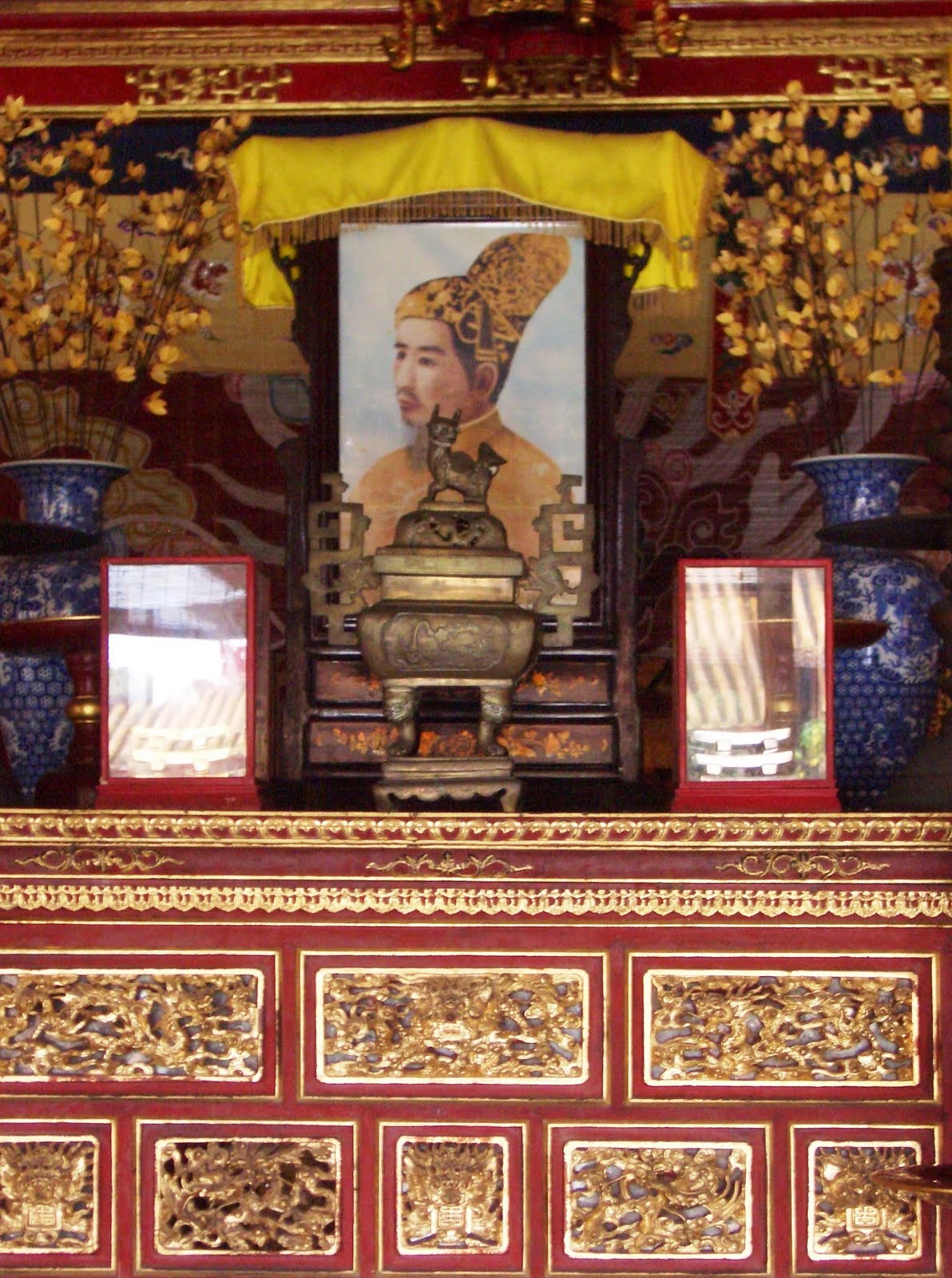
What count among the city’s top attractions are the Royal Tombs nestled in the surrounding hills. Evidently the Nguyen rulers wanted to show that their power continued even in death. Their burial complexes were grand affairs, proclaiming that the cult of memory and ancestor worship was a way for the deceased to manipulate those left behind.

The oldest tomb I visited was that of Minh Mang who ruled for only three years in the middle of the 19th century. His reign marked the last period when Nguyen power was pretty much unchallenged. After his death, the colonial encroachments of the French would eventually render future kings prisoners in their own realm.

What I found so interesting was the fact that once more the projection of state strength did not necessitate that the landscape would be transformed into a monolith of cement. As illustrated by the configuration of the rest of the city, power arose from one’s unity with nature. So it was that the Vietnamese kings’ final resting places were lush gardens, tropical sanctuaries filled with forest and lakes. Minh Mang himself reposed for eternity in the heart of a hill that was perfectly round, verdant with trees.

Tu Doc’s tomb is perhaps the most beautiful of all. Every corner is resplendent with the vibrancy of life. There was even a ceremonial pavilion which housed a theater. It turns out that Tu Doc spent a lot of time here. This was his pleasure palace, his retreat from the pressures of the capital. Ironically, one can read into the sylvan surroundings the need to escape from the reality that the forces of France were now beginning to dominate Vietnam.

Finally, I toured the tomb of Kai Dinh. This is the most ostentatiously decorated. Every surface bustled with porcelain mosaics of twisting branches and agitated blossoms that obscured the gold statue of the king. By Kai Dinh’s reign, the French campaign to annex the country had succeeded. The Nguyens were now mere puppets and all the splendor of their courts and mausoleums merely masked their impotence.

Beyond the boulevards and buildings that testify to the presence of a great metropolis, cities are also marked by absences. To this day it is the remembrance of the destruction of Intramuros which defines the personality of Manila as a community that had lost a part of its soul.

Decades ago, what catapulted Hue into the consciousness of the world was not the grandeur of its palaces and shrines. It was the image of one its citizens, a quiet monk. He had traveled to Saigon to set himself on fire – a magnificent act of protest against the oppressive government that the Americans had helped foist upon his country. Sadly, his martyrdom did not stop the forces that lead to the senseless war which would ravage his beloved Vietnam, resulting in the devastation of many parts of Hue itself.

Yet the monk’s selfless offering was not in vain. The image of him sitting so serenely as his body is engulfed by flames would be burned into the memory of the planet. It was a picture of his self-immolation which captured my attention as a boy, assuring that I would always remember the city of Hue.

The body of the little man from Hue is gone now, his ashes blown away by the wind. Though his death could not hold back the Vietnam War, the image of his passing would always be a symbol of the senselessness of dictatorships, a banner of hope in the face of oppression. His incomparable act of courage will, like his city, remain forever, a reminder that what is erased momentarily in sacrifice will be restored, eternally, in honor.

Friday, December 3, 2010

Hoi An: A Place of Pride


Hoi An: A Place of Pride


When I first mentioned that I was going to spend a week in the Vietnamese town of Hoi An my brothers laughed. They asked me, jokingly, if the people there were embarrassed about something. I then realized that in Ilonggo, our mother tongue, “nahoy-an” means to have been shamed.

When I finally made it to this UNESCO World Heritage site, I would soon realize that there was actually much to celebrate. For one thing, I would be breathing the same air as Brendan Fraser. Yes, the Canadian star was in town at that time to make a movie. We learned about this after my friends and I stumbled on an old house that was being dolled up as a set. It was only after a while that I noticed the grim expressions of the Hollywood crew. We had overstayed our welcome and were now just getting in the way. Much later, when I finally got to watch the film, I found out that we had walked into the setting for a brothel scene!

The ancient port of Hoi An was a place where many cultures have come together. For centuries, Iberian, Chinese, Japanese, French, and Dutch ships have called to exchange the goods of the world in a babel of bargaining. The result is a heady mix. Somehow, many buildings here have the feel of an edifice designed with China in mind, but by someone who has had too much sake and café au lait to drink.
Though the heritage area is not exceedingly extensive, Hoi An can boast of having one of the largest concentrations of traditional shophouses in South East Asia. In a country much devastated during the war with the Americans, the survival of these structures is miraculous. It may be almost cliché but there really is something moving about a streetscape that has not yet been invaded by concrete and steel. Time never stops, except in our heads, but sometimes it is good to pretend.

In fact, despite the present prosperity, reminders of past destruction are never far away. When I took a day trip to My Son, a ceremonial center in the nearby hills that had been in use since the 7th century, CE, we were shown the cavernous holes that had been left by the American bombs. Even more tragic was that these holes represented lost stupas and temples, centuries of toil pulverized in seconds. Returning to Hoi An that night I almost wanted to kiss every pillar, every finial, every delicate stucco carving. The point was painfully made: I was standing on an island, alone, among a sea of villages of equal beauty that had been mercilessly leveled to the ground.

Among the most evocative sights preserved in Hoi An is the Japanese covered bridge. In the afternoons, when the heat is making everyone listless, wandering into its cool shade is such a treat. One questions why the bridge was covered – was there an idea that traversing exposed spans made travelers suddenly vulnerable to lightning or even attacks by airborne witches? I have seen crosses painted on bridges in the mountains of the Philippines too. I suppose it is universal, this primordial fear of transitions, of moving from one sphere to the other.

Looking at this structure that the Japanese merchants had created, one has a sense of leviathans rising from the waves. It is said that it was built on the heel of a monster that was then rendered immobile. Presumably, it was not wont to shake ancient bridges off its feet, especially one so pretty. To memorialize this legendary giant, the local residents erected a small temple tucked into the side of the span. Entering this pocket shrine, my eyes settled on a pair of round knobs which held the lintel in place. Decorated with yin yang designs, these thick discs are called mat cua, watchful eyes that protect many buildings in town from evil spirits. Something was stirring in my mind. Then I remembered. I had seen a similar feature in old Bohol houses like the Casa Rocha-Suarez in Sitio Ubos, Tagbilaran.

Just around the corner from the bridge is the start of the narrow boulevard that runs along Hoi An’s river. At dusk, the view from the other side is magical: the houses are lit with a galaxy of lamps. By their quiet golden glow everything is doubled yet ethereal, an ink wash version of windows, walls, doors. It was on this boulevard, beside this shimmering river, that I had my brush with a star of a different kind.

My friend, Beatrice and I had dressed up in our best Vietnamese style clothes whipped up by local tailors in just one day. Wandering around, we unknowingly entered a district that had been sectioned off for filming. Since we were arrayed in traditional costumes the guards mistook us for extras. Looking up, suddenly, I saw Brendan Fraser materialize right before my eyes, resplendent in a white linen suit. If no less than Sir Ian McKellen could describe him as being “easy on the eyes”, who was to argue? Automatically, I whipped out my camera. As soon as my flash went off the guards pounced. My cameo role was over.

A charming outfit made at the drop of a pin is not the only thing on offer in the cobbled streets. There are also shops bursting with all manner of craft items. Best buys would be exquisitely embroidered pieces. I bought a set of napkins that was decorated with fruits.

I was fascinated with the lantern stalls. These tiny establishments were a kaleidoscope of shapes, all glowing. The variety is astounding. One thinks of the plastic balloons of our childhood taking forms that only innocence can inspire. There are diamonds, orbs and pyramids, flowers of the forest and of the bedroom. The lamps were actually made on the spot, fashioned from bamboo strips and then covered with a silken cloth. At night, when all the other stores have closed, seeing a lantern shop at the end of a deserted street helps you understand why C. S. Lewis wrote about places deep in the earth were gems are still alive, warm, and pliable.

There are also galleries for wood carvers, stone sculptors, and painters. Asking about the paintings, I had to admit that it made complete sense that the top-selling subject would be views of Hoi-an. Since there are more than a million visitors a year, even the most quotidian of trades becomes suddenly attractive. Ambulatory vendors are amazed to be accosted by European customers asking to be sold warm loaves holding slivers of the local pates. Tailors, calligraphers, sign makers, bakeries, even pharmacies all do brisk business because their wares are transformed by the tourist gaze into quaint souvenirs for multitudes hungry for the imagined echo of another epoch.

Not all the houses have been converted into shopping havens. Some are pleasant inns or interpretation centers, museums that help explain the lives of the local residents. Still others host lectures and evening performances of time-honored dances and songs. An omnibus fee is charged for many of the sights as well as for the entire heritage district. The funds collected are used for maintenance and conservation.

Hoi- an is famous for its food. Its specialty is cao ha. The soft doughy noodles are prepared using water that must be drawn from a specific well in town. Mixed with vegetables and a rich broth then topped with croutons, each mouthful speaks of a long line of palates refined by history. And of course there is always coffee, conjured right on your table with your personal brewer, a metal filter that is fitted on your cup. Even more innovative are the little stands designed especially for the can of condensed milk which is used as a sweetener. Since ants are so enamored with the sticky stuff, the stand has a hollow all around its rim. Filled with water it becomes a tiny moat to keep away sugar-starved insects.

Sitting in a café that has been adapted from an old house, sipping your warm beverage, with all these little brewing implements set out in front of you is so satisfying. But what is the source of the feeling? Is it the knowledge that the structure you are in has been reborn, given a new lease on life? Is it the smugness that arises because you are now familiar with these miniature coffeemakers unlike the astonished tourists at the other table? Though you are in a different land, you are on smiling terms with some of its ways.

Part of the appeal of the cuisine is the narrative that peppers every serving. One such tale is that of Ms Vy. Back in a time when Hoi An was still off the beaten track, Ms Vy had been among the first to open a restaurant. Now she oversees several establishments, among them the Mermaid Café, the Morning Glory, and the Cargo Bar. Each one serves dishes with a slightly different inflection, all delicious. Today, this enterprising woman has a new venture: a school for Vietnamese cooking.

Having been unable to enroll for a class, I contented myself with visiting the room where sessions were held. It was bright and airy, with high ceilings as well as burnished wooden beams and pillars. One window was the backdrop for a jar of flowers. Another presented a broad view of houses clustered together, absorbed in memories. Each student would get an assigned station equipped with a personal stove. What a wonderful place for learning!

The instructor’s table had all the ingredients arranged in a tantalizing array. Glossy black bowls held garlic and ginger. Bottles in a row contained powders ground from aromatic barks as well as leaves, fruits, and seeds dried under an indulgent tropical sun. Over the table was a huge mirror so that each budding chef would not miss the culinary calisthenics of the master.

Thinking how much Vietnam had suffered, thinking about all those photographs of the senselessness of the American War, remembering the many boatloads of refugees who braved maritime dangers in dilapidated boats to escape the horrors at home, one can only be glad for Ms Vy. She and so many others like her have shown us that it is possible to craft a brave new life even out of destruction.
Surveying the lanes of houses so lovingly conserved or even wandering among the vegetable markets with their fragrant towers of lettuce, coriander and basil, one cannot but give thanks for one more world unextinguished. Remembering how much we too have lost to wars, recalling places like Intramuros, Lipa and Pagsanjan now just shadows of their former selves, one says a prayer of gratitude for everything that still survives, for every town and edifice that continue to lend many more meanings as well as restore pride to our lives

This writer would like to thank Choy Urra of Global Nomad Bespoke Tours for providing information, Tran Trong Kien of Buffalo Tours for trip arrangements, and Cenon Agbayani for use of his photo.