Showing posts with label UNESCO World Heritage. Show all posts

Thursday, August 18, 2016

Anhui: Communities of Meaning

text and photos by Ino Manalo


Watching the movie Crouching Tiger, Hidden Dragon by Ang Li, I was entranced by a scene where a number of combatants leap across a pond, their feet barely grazing the surface. I vividly recall that the pond was surrounded by ancient houses whose dignified facades were reflected in the water. 


Later, when I saw an exhibition about the domestic architecture of Anhui and learned that the unforgettable movie sequence was shot in a small community in this province, my resolve to visit the place grew.

The opportunity finally came during a trip to Huangzhou with Liwayway/Oishi Corporation. Our hosts very graciously agreed to arrange a side expedition to the ancient hamlets of nearby Anhui. Finally I was going to see my pond. As it turned out , there was much more to discover than just this body of water.


Two of the Anhui villages, Xidi and Hongcun have preserved their traditional structures so beautifully that they were placed on the UNESCO World Heritage List in 2000. Now, being on the list actually has its pluses and minuses. On one hand, it brings glamour and recognition. On the other hand, the many visitors that show up may tax the carrying capacity of a site. Sometimes, there are even protests that tourists are displacing local residents.


I wondered what the situation was like in Xidi and Hongcun. Did the houses still retain their original stewards?  

Walking around the time-polished lanes, I couldn’t help thinking: what was it like to live here in the 19th and early 20th centuries when these two villages were among the most prosperous in the land? What was it like to go in and out of these homes, visit one’s neighbors, buy a bucket from an itinerant salesman?


Though I was now a tourist examining what was essentially a heritage showcase, there was still so much to discover and discern. Round a corner and one spies a broom propped against a wall, push open a gate and there is a courtyard with a canopy formed by delicate vines from which fruit are impossibly suspended. 


Glancing through a doorway, I saw a violin lesson in progress. What amazed me was that the mother was actually holding up the music piece for her young protégé. I felt like I was sharing in a cherished album, or witnessing the unscrolling of a fragile painting. Little by little, fleeting insights were thrown in my path, perhaps in jest, perhaps as an earnest invitation to explore further.

I began to understand that the way traditional dwellings were designed and even the manner that they were distributed on the terrain could be read as virtual guides or maps. These helped instruct residents on the gentle art of living.  As one writer has pointed out:  the Chinese residence “is structured to shape family organization and to weave the web of social and ethical norms that linked the household to the world beyond. “
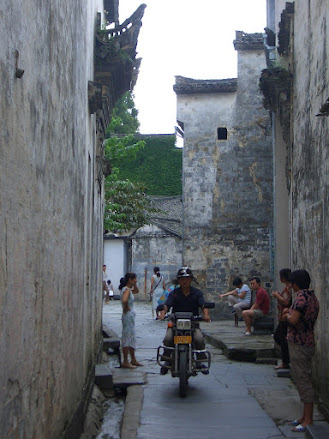

Likewise, these jumbles of alleys and walkways that I was negotiating followed patterns that were honored and repeated all across the realm. Hongcun and Xidi were both sited so that they were embraced by water and buttressed by solid mountains. This is a feng shui specification that one will see even at the Forbidden City in Beijing, countless leagues to the north. As above, so below – such it has been and always will be for the Celestial Empire.

The lay-out of Hongcun itself is said to resemble a cow. Forming the head at one end is a hill with its two tall trees representing horns. The four bridges are the legs while the canals that circulate throughout the town are likened to intestines and veins. At the very center is the Moon Pond of Crouching Tiger fame. This is considered the cow’s stomach.


The bovine metaphor, amusing as it may seem at first, can impart many lessons to the inhabitants. First there is the recognition of humans’ relation to the land. It is our environment – lakes, rivers, mountains, forests  - which gives us our context. Feng shui may seem like superstition to some but at its heart is the realization that we must all engage with the harmony of nature.

Then there is the primacy given to our fellow creatures. Farm animals, especially, are accorded their due respect since without them our own lives would be much reduced. Perceiving that one’s hometown is shaped like a cow (as opposed to an airplane in Brasilia!) is a reminder that we must recognize the roles of other species in our biosphere.


That canals are thought of as intestines and veins stresses the importance of water. We cannot live without water in the same way that we will expire without blood or digested food coursing through our bodies. The capillary comparison is, simultaneously, an admonition not to forget that we are all inter-related. A blockage or a breakdown in one part of the network could wreak havoc in another area. One cannot throw garbage into the canal system as this would affect one’s neighbors who may decide to be as cavalier with you.
Every building in these villages arises from and is enveloped by a fabric of symbols. Doors are flanked by a pair of ornaments in the shape of drums and other objects to announce the main occupation of the family. The number of steps corresponds to established codes of meaning. Vestibules in Southern Anhui always contain a table on which is set a clock and a vase as these are considered auspicious.  There are, as well, lattice screens carved with a design of randomly arranged triangles, a motif known as “cracked ice”. These are meant to help one contemplate the difficulties and complexities of life. A variation has flowers interspersed with the triangles. Perhaps these suggest a reprieve from all that hardship. 
A townscape is effectively a three-dimensional record, a palimpsest of a people’s history. Mud stains may reveal how high the waters had raged in a great flood. Blackened areas grimly commemorate a fire or even war. A battered fence may bring back one’s childhood.


Outside the village of Xidi there is a winding path that passes under several exquisite stone arches. These are memorials to the achievements of certain residents. Usually their accomplishments have to do with hurdling the Imperial Examinations paving the way to an illustrious career in the Civil Service. Sometimes, the arches are erected for filial sons and even for devoted widows.   In this way, individual diaries and family records merge with the archives of a community. Village history is  inscribed on rock so that all may see and in seeing, remember.


Though Xidi and Hongcun had been prosperous villages,  with the reduction of rural populations in the 20th century, the vitality of these traditional communities began to wane. Fortunately the rediscovery of these heritage enclaves has brought new life as engendered by income from the tourist trade.  Many who come have apparently seen the same gracefully choreographed cinematic fight scene as I did. This is evidenced by the great increase in arrivals after the release of Ang Li’s film.

In a way, a formula is taking shape. Centuries ago, once wealthy towns were able to afford elaborate buildings. As the years roll by, a reversal in fortunes ironically ensures that there is no money to tear down these singular structures to set up others according to the tastes of the minute. Matchless edifices are then preserved for the time that they are stumbled upon by the historically inclined. Once these pockets of the past become well-known, hordes of travelers begin to descend. Everyone is hoping for an encounter with origins as couched in the comforts of the internet, fastfood and a spa or two. One notes this tale repeated all over: Anhui, Hoi An, Pingyao, Lijiang, and even our very own Vigan.


The danger is that heritage towns become parodies of themselves all in the name of tourism. As the sociologist John Urry has warned in his tome, The Tourist Gaze, travelers have a way of rendering all that they see as consumer products. Crafts become souvenirs, residents become quaint natives, sacred rituals become spectacles. One way to counter this homogenizing vision is to celebrate the uniqueness of every place as developed by the aspirations of the people who live there.

Certainly, many have complained about the commercialization of Hongcun and Xidi. At the other side of these complaints, however, is the question: if it were not for the travel industry, how else would the villagers survive?


I suppose that the challenge is finding a balance between creating livelihood opportunities and maintaining the integrity of traditional environments. It has to do with understanding that the real attraction of a place is the vibrancy of its own community life.  It has to do with realizing that what makes our dwelling places flourish is the rootedness in the fertile soil of meanings, symbols, and ways of knowing. These have always provided sustenance and consolation in a shifting and shifty world.
Perceiving the nuances in the vast wealth of messages provided by the fascinating albums, guiding maps, patchwork cloaks, and palimpsests that are the villages of Anhui may just be the beginning. But it is a good place to start.


The writer would like to thank Carlos and Carlson Chan of Liwayway/Oishi Corporation for their patience and hospitality.


Friday, December 23, 2011

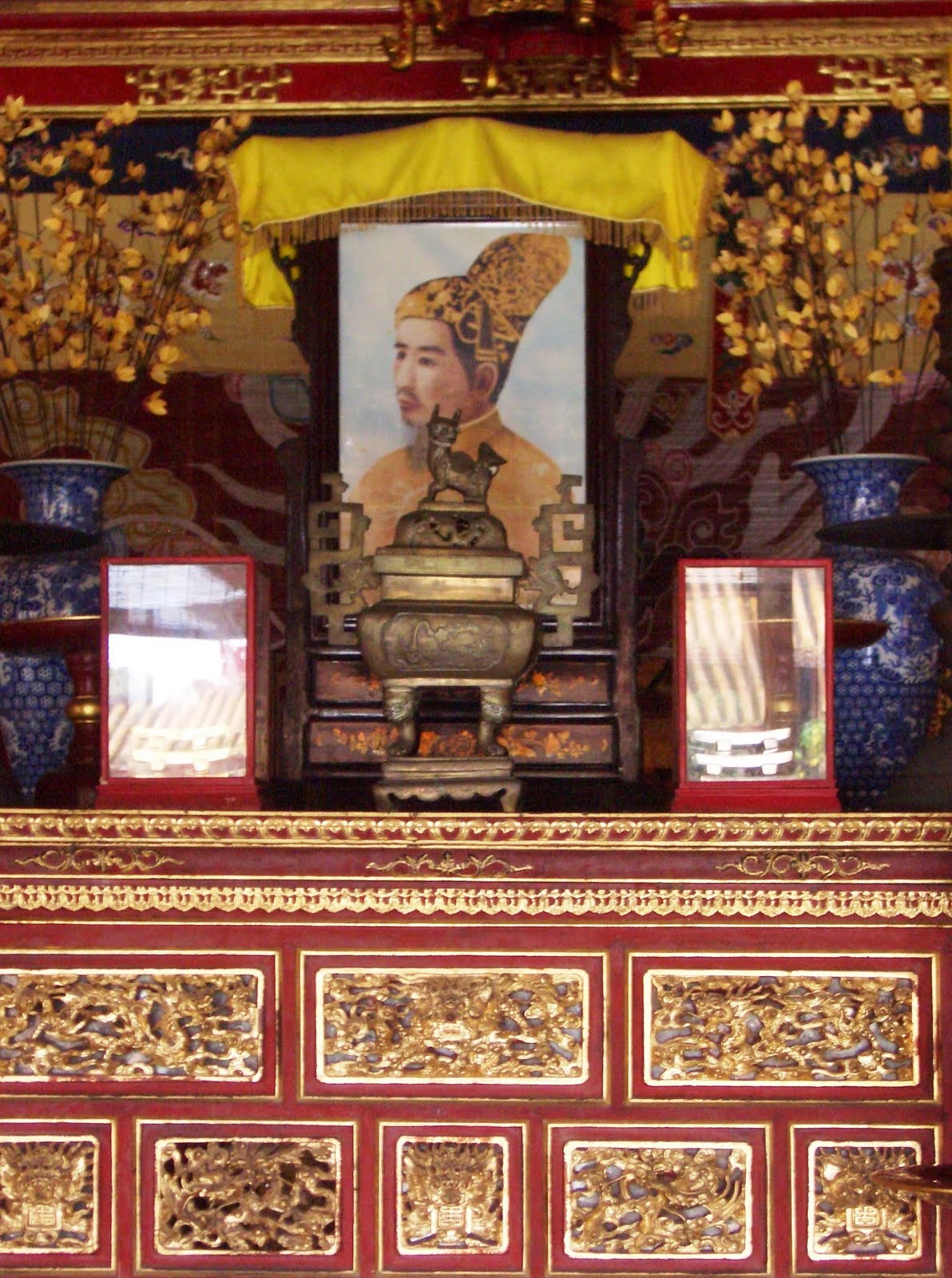
Hue


For all they project of being eternal and monumental, cities are malleable like clay. Their edifices and districts are easily molded in accordance with the desires of their builders.

Spanish Manila reflected the conquistadores’ fear of insurrection and contagion. The massive city walls were supposed to preserve Hispanic security as well as an illusory purity of blood. In contrast, America’s draconian military might established broad boulevards and Neo Classical government palaces outside the original Spanish enclave. Intramuros as fortress was made obsolete and unglamorous by developments in the technology of warfare and of hygiene. Much later, vast swaths of lands would rise from the sea to accommodate the visions of the New Society.

So it is with Hue, the former royal capital of Vietnam. I could sense that though much of the city was destroyed during the war with the Americans, there was a certain dignity that one did not immediately detect in Saigon and Hanoi. Were the residents of Hue just more aware that theirs was a place carefully fashioned as the stage for the official pageantry needed to rule a nation?

When the Nguyen dynasty consolidated the country at the dawn of the 19th century, the city was re-engineered to reflect the concerns and whims of its rulers. Foremost was the need to create an illusion of power. In the early 1800s, it appears that, for the Vietnamese, being powerful meant being in harmony with and therefore able to harness nature. One also had to have the support of China or was at least capable of emulating the Celestial Empire.

According to an essay by Nguyen Van Vinh, Hue was laid out in accordance with the principles of geomancy as practiced all over East Asia. The capital’s site was chosen because it was protected by mountains known as the Emperor’s Shield. The Hen and Va Dien Islets were seen as a Blue Dragon and a White Tiger guarding the metropolis’ flanks.

In another display of dynastic strength, the Pearl River was rerouted to flow in front of the Imperial compound forming an umbilical cord that brought vitality and sustenance. This, together with the mountain backdrop, mirrors the arrangements of China’s Forbidden City as dictated by the requirements of feng shui. In fact, the edifice that marks the entrance to the palace complex in Hue is practically a replica of the Meridian Gate in Beijing.

Under the French colonial regime, the capital underwent more changes as dictated by the predilections of its new masters. The spires of Roman Catholic cathedrals would puncture the skies. Administrative structures were erected in novel styles representing global movements such as Art Deco.

When the Communist liberated their country, they too would place their mark on the city. A huge post from which unfurled an enormous flag of the reunited Vietnam was placed on Hue’s fortress, the Citadel. The flag’s colors signaled to all that the People’s Revolution had triumphed at long last.

There were more subtle changes. Working out in a neighborhood gym, I was fascinated by the curving modernist lines of the structure in which it was housed. Outside, there was a strange tower with even stranger round holes in the center of the ceiling. It suddenly hit me that this was actually a belfy. The holes would have been for ropes attached to bells, now long gone, rung in the past to call the congregation. Yes, my gym had once been a church. In a space now dominated by home-made weight machines and large posters of Ho Chi Minh, masses had been said. Clearly, the current regime believed that arms pumping iron superseded knees bent in prayer!

Aside from the more obvious meanings, Hue harbored other narratives. I was taken to see the Temple of the Mandarins, a compound which celebrated those who passed the examinations for civil servants. Hurdling these tests meant the assurance of a life of financial rewards and eminence. The carved stone tablets extolling the virtues of the bureaucrats surrounded us. These were monuments to the patriarchy, celebrating male dominance of the establishment.

Providing a fascinating counterpoint to all this smug and strident masculinity was a different temple which housed the burial places of the palace eunuchs. Entering the grounds, one is greeted by a large pond in the shape of a half moon. Its limpid waters signal that this is protean enclave of shifting, negotiated meanings. In contrast to the straight lines and vertical shapes of the Mandarins’ shrine, the gravemarkers here were rounded, with contours softened by moss.

What count among the city’s top attractions are the Royal Tombs nestled in the surrounding hills. Evidently the Nguyen rulers wanted to show that their power continued even in death. Their burial complexes were grand affairs, proclaiming that the cult of memory and ancestor worship was a way for the deceased to manipulate those left behind.

The oldest tomb I visited was that of Minh Mang who ruled for only three years in the middle of the 19th century. His reign marked the last period when Nguyen power was pretty much unchallenged. After his death, the colonial encroachments of the French would eventually render future kings prisoners in their own realm.

What I found so interesting was the fact that once more the projection of state strength did not necessitate that the landscape would be transformed into a monolith of cement. As illustrated by the configuration of the rest of the city, power arose from one’s unity with nature. So it was that the Vietnamese kings’ final resting places were lush gardens, tropical sanctuaries filled with forest and lakes. Minh Mang himself reposed for eternity in the heart of a hill that was perfectly round, verdant with trees.

Tu Doc’s tomb is perhaps the most beautiful of all. Every corner is resplendent with the vibrancy of life. There was even a ceremonial pavilion which housed a theater. It turns out that Tu Doc spent a lot of time here. This was his pleasure palace, his retreat from the pressures of the capital. Ironically, one can read into the sylvan surroundings the need to escape from the reality that the forces of France were now beginning to dominate Vietnam.

Finally, I toured the tomb of Kai Dinh. This is the most ostentatiously decorated. Every surface bustled with porcelain mosaics of twisting branches and agitated blossoms that obscured the gold statue of the king. By Kai Dinh’s reign, the French campaign to annex the country had succeeded. The Nguyens were now mere puppets and all the splendor of their courts and mausoleums merely masked their impotence.

Beyond the boulevards and buildings that testify to the presence of a great metropolis, cities are also marked by absences. To this day it is the remembrance of the destruction of Intramuros which defines the personality of Manila as a community that had lost a part of its soul.

Decades ago, what catapulted Hue into the consciousness of the world was not the grandeur of its palaces and shrines. It was the image of one its citizens, a quiet monk. He had traveled to Saigon to set himself on fire – a magnificent act of protest against the oppressive government that the Americans had helped foist upon his country. Sadly, his martyrdom did not stop the forces that lead to the senseless war which would ravage his beloved Vietnam, resulting in the devastation of many parts of Hue itself.

Yet the monk’s selfless offering was not in vain. The image of him sitting so serenely as his body is engulfed by flames would be burned into the memory of the planet. It was a picture of his self-immolation which captured my attention as a boy, assuring that I would always remember the city of Hue.

The body of the little man from Hue is gone now, his ashes blown away by the wind. Though his death could not hold back the Vietnam War, the image of his passing would always be a symbol of the senselessness of dictatorships, a banner of hope in the face of oppression. His incomparable act of courage will, like his city, remain forever, a reminder that what is erased momentarily in sacrifice will be restored, eternally, in honor.

Monday, December 13, 2010

Is there Mongolian Barbecue in Mongolia?


Text and photos by Ino Manalo

The mention of Mongolia would, for me, evoke images of a thousand horsemen thundering across vast plains . What a disappointment then to arrive in the nation’s capital, Ulan Bator, with its nondescript structures of steel and concrete. Since the Soviets had once been so influential in Mongolia, people observe that Ulan looks like so many of the smaller cities in the USSR.

Walking around at dawn as is my custom, I found myself in the midst of bland apartment blocks. I was getting the impression that everything was so grey, so unremarkable, and then I saw a pack of dogs. There was an air of primordial power about them, an arresting, mesmerizing vitality. Clearly, I shouldn’t judge the vibrancy of Mongolia based on my views of its capital. After all, this was a nation whose forbears had ruled an empire that stretched all the way from Asia to the very gates of Europe itself.

Only by driving out of the metropolis does the country in one’s mind come to life. The plains are astounding indeed: dry, empty, never-ending. It is easy to forget that oceans exist and that the earth’s surface is covered mostly by water. In Mongolia there is only land.

I had to ask our driver to stop so that I could savor the view. Being from an archipelago embraced by seas, it was actually disorienting to survey this boundless terrain. Everywhere one turned was a trackless, empty wilderness. It had snowed the night before and the gleaming white landscape that now stretched before me could not be more alien to my equatorial perceptions.

I suppose it was the emptiness that was so novel, so disconcerting. For Mongolia is a largely uninhabited place. With a population of just 3 million occupying territory ten times larger than ours, there are whole areas where one would not encounter another soul for miles around. For that matter, one would not find trees or houses too, just a huge flatness.

So flat is the land, in fact, that motorists have no qualms about traversing it without the benefit of asphalt. At one point, the highway we were on was blocked due to repair work. Suddenly, I found that our vehicle had simply charged into the open plain. For what seemed like hours we drove, surrounded only by the featureless desert, accompanied by armies of tumbleweeds rolling with the wind. Other cars passed us nonchalantly. People here were obviously used to the idea that the plains were one vast roadway without roads.

Finally we reached our destination: the Orkhon Valley, site of Karakoram, former capital of the Mongol empire. Unfortunately it was very dark when we arrived so I would have to wait till the next day to take in the sights. It was also bitterly cold. That night I had to beg for two heaters just to keep soul and tropical body together.

After breakfast , I was asked by my kind hosts what I would like to eat for lunch. I brightly suggested “Mongolian barbecue”. Back in the Philippines after all, this meant a delicious dish of rice fried with the tastiest morsels of one’s choosing. My hosts were puzzled. They had never heard of such a thing. Yet, amused that such a bizarre concoction could bear their name, they gamely agreed to give it their best shot. I would be served increasingly creative versions of Mongolian barbecue everyday for the rest of my stay.

Climbing a hill, I at last got to see the main objective of our trip: the great temple of Erdene Zuu. It was here that I was to conduct a seminar on UNESCO World Heritage and Education for Sustainable Development for Mongolian teachers. From my elevated vantage point, I gained an understanding of how large was the sacred precinct surrounded by a massive wall. But I also saw the empty spaces indicating how so many of the buildings within the complex had been destroyed. Sadly, during the height of the Soviets’ influence there had been a campaign against organized religion.
Coming closer one cannot help but marvel at the rows of towers that mark the perimeter of Erdene Zuu. How proud they look, gleaming white against the impossibly blue sky. One falls silent pondering the centuries of devotion and drama that this enclosure had witnessed.

The Orkhon Valley had been at the crossroads of the commerce of ideas and goods between many peoples. One can still see in Erdene Zuu, marks of these international exchanges. The temple complex boasts of images and architectural features that reveal linkages with India, Tibet, China, Korea and Japan. There are stones carved with Mongolian, Tibetan and Indian writing.
Surveying the surviving pavilions one gets a sense of the many craftspeople that must have come together to erect this marvelous compound. Carpenters, masons, painters, embroiderers, sculptors – all would have been busy for years. One also gains an insight into just how an ancient monument is really a testimony to the environment that produced it. Acres of earth had to be dug up and transformed into bricks, whole forests had to be felled for the beams and columns. Often it was no longer possible to reconstruct an old building simply because it was so difficult to find trees big enough to fashion pillars as massive as that of the original.

The walls of Erdene Zuu are covered with illustrations of the complex beliefs of the Mongolian people. One image I found quite compelling was a picture of a sky burial, with the entrails and limbs of the deceased hung out for vultures to consume. I was admiring the everyday scenes filled with horses and sheep when I caught sight of something vaguely familiar: a pack of dogs. The painted canines looked so much like their flesh and blood counterparts that I had seen a few days before. So it was: Erdene Zuu and its murals are testaments to the continuity of Mongolian life. Yet in the courtyard one will also see the bases which had once supported the columns of structures that had probably been demolished under the Soviets. Heritage buildings, after all, help us realize that our histories are as much marked by absences as by presences.

The high point of my visit was meeting the Grand Abbot. He allowed me to sit with his monks during their prayers. He told me of his mission to rebuild Erdene Zuu. Though solemn at first he lightened up as we got to converse more. He interrupted our discussions periodically to sip tea from a white bowl which I noted was quite lovely with its subtle decoration.

The Abbot even joined in quite wholeheartedly during our seminar exercises. I was quite nervous when I had to deliver a presentation on Erdene Zuu. Perhaps the audience, led by the temple’s venerable elder, would find what I had to say preposterous. Fortunately, my lecture was enthusiastically received. When it was time for me to go, the Abbot presented me with a gift wrapped in a scarf. I would learn that it was the bowl that I had admired.

During our trip back to the city, I asked about some stupas on a hill in the distance. Sensing my interest the driver once again cavalierly drove our vehicle into the desert. It turned out that the cluster of stupas actually marked the very center of Mongolia.

Standing there, in what was in effect the navel of this land, I surveyed the grand vistas around me. One knew that beyond the horizon lay the many regions that had all been part of the Mongol realm. I fell to thinking about the people that I had spent many days with. I recalled how I had asked them during the workshop to create a large mural of their vision for the future of the Orkhon Valley. I remembered how they had foreseen that someday there may be more factories and more tall buildings. Someday there may even be an airport. Yet what I found most interesting was how everyone agreed that, whatever else happened, Erdene Zuu would be restored.