Showing posts with label heritage tourism. Show all posts

Sunday, June 24, 2018

Designing Tibet


Painting by Nicholas Roerich 

Rummaging through the bins of a second-hand store in Makati, I came upon a volume with a curious title:  "Imagining Tibet”. That’s  when it struck me that, indeed, the Land at the Roof of the World is a place that exists not only on this planet but in our minds. 

The 1957 book by Peter Goullart, Forgotten Kingdom and the more recent Searching for Shangrila by Laurence Brahm (published in 2003) are additional examples which show how this entire region has been mythologized by writers from the West. The lovely paintings by the Russian mystic Nicholas Roerich of lonely citadels set in an expanse of mist shrouded peaks also helped to further enhance European fascination.

This fascination probably has something to do with His Holiness, the Dalai Lama himself. After all, the idea of how he was selected by searching throughout the land for the new incarnation of the departed ruler is truly enchanting. I suppose in an increasingly callous era, such a magical way of choosing a leader is certainly cause for pause.

Cover of Tintin in Tibet

In my case, this mountain realm first entered my imagination through a beloved comic book: Tintin in Tibet. As it turns out, this particular adventure is the favorite of many other fans of the young reporter. A friend of mine theorizes that this is because the story involves a selfless rescue in a faraway land. There is a journey on the icy slopes of the Himalayas, the weird but ultimately very human migou or Abominable Snowman, the unfathomable wisdom of the grand abbot, and the encounters with other forms of knowledge that took in stride clairvoyance and levitation.

Then again, as the tale of Tintin and his partner, Captain Haddock, unfolds, one glimpses in the colorful illustrations the solid square buildings whose interiors were brightened by rich textiles and polychrome statues. There were the sacred monuments known as chortens or stupas which held the relics of holy monks. 

One can even share in the sense of relief which the characters in the book must have felt when, after being knocked out by an avalanche, they awoke inside a monastery. All this made for an enchanting read, adding more images to the world’s concept of this fabled place.

A view of a monastery from Tintin in Tibet

Monastery interior 


Traditional bench


Given my early exposure, it was with a child’s joy that, while exploring the Eastern flank of what had once been part of the ancient territory of Tibet, I realized that I could recognize my surroundings.  The building silhouettes and the architectural details, the window shapes, even the brilliantly colored furniture and sculpture – all these were familiar to me because of Tintin.


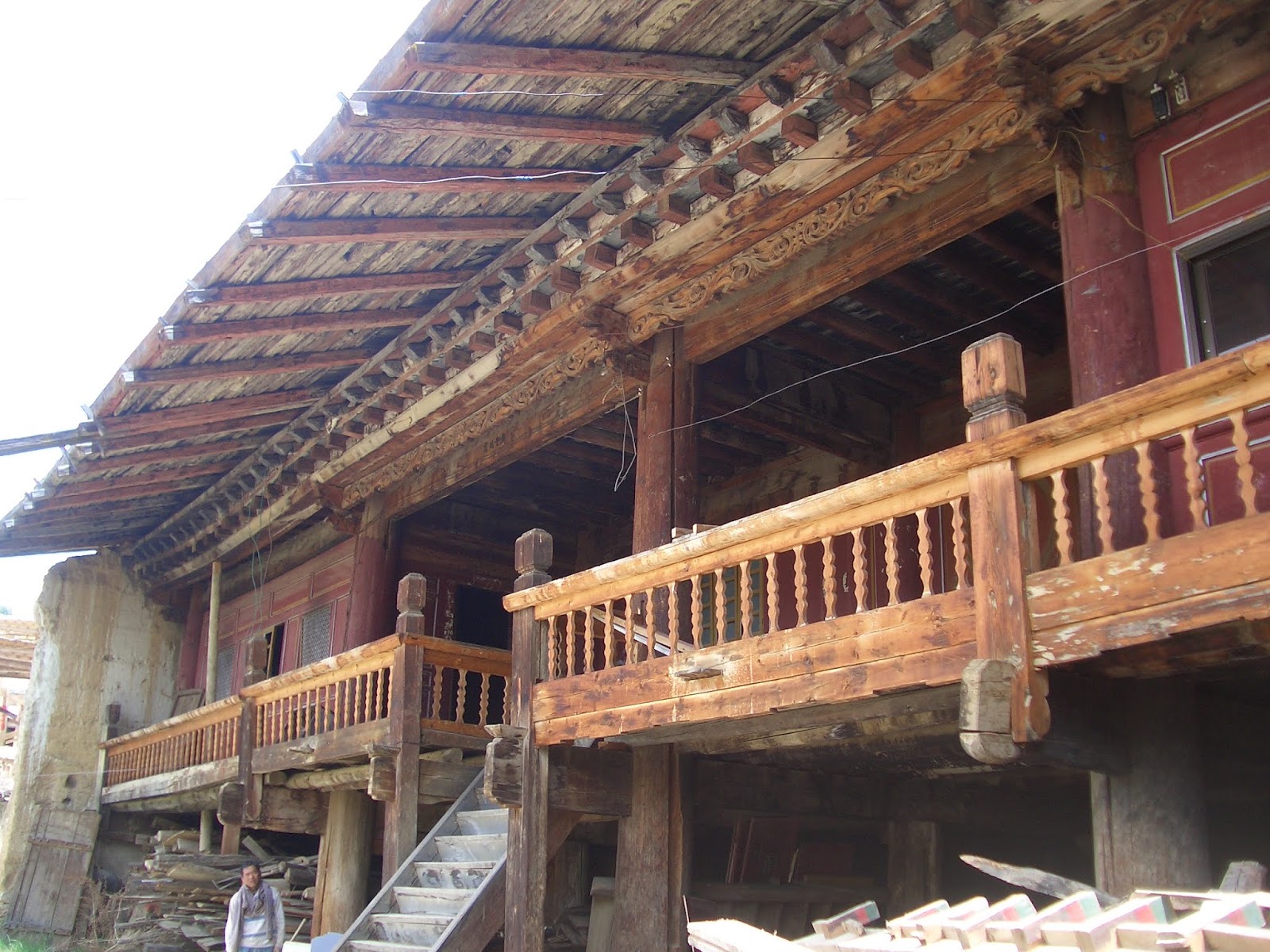
Weathered facade of an old house in Dukezong


We were exploring Dukezong, the heritage quarter of Zhongdian, a town that had once been an important outpost on the traditional trade routes between China and the Himalayan kingdoms. Our host took us inside an old Tibetan house, entering through a crumbling gate that was overgrown with weeds. The interiors were quite dim yet I could still make out magnificent murals depicting the sacred symbols associated with the Buddha.

Interior of traditional houses


Outside, the district was all abuzz with many fashionable tourist establishments. One café-gallery we entered preserved the same homey feel of the antiquated house we saw. The wooden furnishings were lovingly preserved so that one could relish the time-worn textures which contrasted with the jolting colors of the throw pillows.


Heritage tourism in Dukezong utilizing local resources


In our host’s office we saw the same technique of introducing traditional touches into contemporary settings. The meeting room had a canopy and curtains festooned with the same sacred symbols we had seen in the residence. 

Meeting room with traditional patterns in an NGO office 


When I mentioned that the tranquility of the chamber made it the perfect place for conferences, our host explained that the decorative scheme was inspired by his advocacy to safeguard the historical dimension. For centuries, the cold stone spaces of Tibetan structures were always softened by draperies – reminding the occupants of a nomadic past lived out in tents made more habitable by blankets and carpets.

I would notice this same concern to marry the traditional with the contemporary in the Banyan Tree Resort in nearby Ringha. The setting alone is already so emblematic of the region. One drives through sleepy villages and mountain valleys dominated by distant snow-bound summits. I was reminded that this is the land that the great botanist Joseph Rock had come to love during the years he spent here searching for plant specimens.

The area has some of the richest bio-diversity in the planet because of the various micro-climates created by the varying altitudes. For this reason, I even suggested that the resort could offer flower collecting expeditions where guests could go out into the surrounding countryside accompanied by experts to learn about the unusual flora. Non-endangered examples could then be collected and, after a blossom-pressing or drying workshop, transformed into quaint cards or frames.

A view of the resort

Entering the Banyan Tree, I felt that I had simply wandered into another section of one of the villages I had just visited. As one of the resort owners explained to me, they had dismantled abandoned vernacular houses and moved them to the site. It was actually more cost-effective to do this since buying fresh materials to erect an entirely new building would have been much more expensive. What gave the resort a sense of cohesion, though, was the fact that the houses had come from the same locality and were stylistically related to each other.

Racks used for drying corn decorating the resort


I was amused to spy about the grounds the huge racks which the villagers would use to dry corn or peppers. An administrative office was even set-up in a tent. I noted too that the entrance façade of the spa was exactly like that of the house in Dukezong but it was livened up with jaunty lanterns. Meanwhile, the guest cottages had gates that would have fit right into any streetscape in the region.

Facade of a house in the Old Quarter of Dukezong

Facade of the resort spa
The bedrooms once again featured brilliant fabrics juxtaposed with gnarled beams. Beautiful thangka-like paintings were everywhere adding a meditative salve to the already soothing interiors. I noted interesting innovations such as drums used as side tables and a huge wooden bucket fashioned into a soaking tub. I was happy to learn that the restaurant menu featured an adaptation of my favorite Tibetan dumplings whose name I find inexplicably comforting: momos!

Resort interiors


Resort shop

Tibetan drum used as side table


 What impressed me most though were the elements that spoke of a more spiritual dimension. The paths that connect the guest cottages are not smoothly paved but covered with large stones rounded from having spent an eternity at the bottom of rushing alpine streams. Since it is not easy to walk on these uneven surfaces, one is initially puzzled: why had such an inconvenience been introduced? Then one realizes that these unusual paths allude to the deep spirituality of the Himalayan peoples. 

Resort path with large stones


Woman from Dukezong Old Quarter


All throughout Tibet, pilgrims come to sacred spots to pray and perform rituals. One remarkable practice is to circle a holy site while remaining completely prostrate. What makes this especially difficult is the roughness of the terrain which is filled with skin-piercing rocks. There are also the great distances involved: sometimes what is being circled is not just a temple, but in the case of Mt Kailash, an entire mountain.

Interestingly, the whole Banyan Tree compound is dominated by a ridge on which the developers had built three chorten. These were eloquent indicators that though this may be a plush resort, it was also a sanctuary, an integral part of a magnificent land that had endured so much through the centuries.
Old door in Dukezong
Resort Doorway


Some may find the use of religious imagery in resorts inappropriate. There have been whole discussions on how tourism can commodify even what is sacred. For me, though, I am grateful for the reminder that travel is not just about pleasuring the body but also about nourishing the soul.


The writer would like to thank Lorenzo Urra of Global Nomad for recommending The Banyan Tree in Ringha.


Taal: Surviving with Grace


Taal: Surviving with Grace

Old map of Taal from the Mexican Archives


Unaware that Taal is the name of a genteel town filled with heritage architecture, many people confuse it with Tagaytay.  I guess it has to do with that magnificent view. Mesmerized by the sapphire oval of water and its eruption-prone occupant, many think of the City on the Ridge instead of the former capital of Batangas province after which the lake itself is named. 

In the 18th century , Taal actually stood right on the shores of its namesake. A map I was recently given by the visiting director of the Mexican Archives, Dr Aurora Gomez Galvarriato (who came to Manila courtesy of her Embassy) revealed major settlements on the water’s edge where there are none today.  Apparently, the lacustrine communities had been enduring the temperamental outbursts of the tyrannical volcano for decades. The eruption of 1754 was so cataclysmic, however, that the people finally gave up and moved away. All that remains are the ruins of the old church.

Ruins of the old church of Taal


The town of Taal relocated to a site atop Caysaysay which had, in the past, been a far-flung barrio. One can just imagine what such an exodus must have entailed: It would have been a day darkened by the clouds of ash covering the sun. In the distance was a glowing column of fire spewing from the volcano, fearsome harbinger of death.

This terrible journey through a black abyss is actually recorded in the words which accompany the Subli, a traditional dance that the Batanguenos perform during special days. Despite the dangers, the Taal folk pressed on, braving the stifling darkness to seek a new place for a new life.

Dancing the Subli


I consider myself fortunate because I have had a chance to witness how this life eventually flourished. As a boy, I had the pleasure of being invited to spend weekends with the various members of the Laulhati Family who are well-known citizens of Taal.

Old houses on Calle Real, Taal


One of the Lualhati ladies, Mrs Herminia L. Alcasid is the mother of Tony, a classmate of mine.  Her other son is the singer, Ogie Alcasid. Tony would bring me along during our Holy Week breaks or at fiesta time in December.

Having grown up in the concrete barrios of Makati, I was completely entranced with this cradle of culture: the three storey houses on the plaza, the strange carved sea-stone arch in the middle of a forest, the simple but glorious food.  I also grew to love the pageantry of the processions and the devotion which radiated from the pabasa or readings of the Passion in front of the bloodied statue of the dead Christ.

Basilica of Taal


Through the years I would listen while Mrs Alcasid (or Tita Minnie as we called her) endlessly discussed with her sister Mrs Ligaya Tankeh (or Tita Aya) how to restore the town’s monumental temple, the Basilica of St Martin. I recall how they regretted that one of the original wooden retablos had been replaced by a cement construction and how concerned they were that the pendentive paintings of the Four Evangelists had been lost. It seemed that something else always needed fixing in this ancient community and the two sisters never tired of rising to the occasion. While Tita Minnie was involved with CHARM which focused on the church, Tita Aya headed the Taal Heritage Foundation which covered practically everything else.

Under Tita Aya’s leadership, the Foundation acquired an old house which was transformed into a bed and breakfast. So dedicated was this admirable lady to her conservation work that she even braved a court case when her right to use the house was challenged. I even remember , back in the days when my own  interest in heritage work was just beginning, feeling so honored when Tita Aya invited me to a meeting with former mayor Fe Cabrera to discuss historical preservation options for Taal.

The Lualhati siblings were by no means alone in their task. Later on I would meet Dindo Montenegro  who organized wonderful tours complete with craft showcases. There were also the descendants of Dona Gliceria Villavicencio, who have  restored the houses that this formidable heroine of the Revolution had left them. Ernie Villavicencio worked with his vivacious wife Ria who is an interior designer. The couple, together with the current mayor, Michael Montenegro, would go on to found the Taal Alliance which was dedicated to revitalizing their beloved town.

Craft demonstration

Since its inception, the Alliance has undertaken many important heritage programs such as a comprehensive cultural mapping of the entire municipality. There are also plans to coordinate more closely with the National Historical Commission headed by Dr Maris Diokno which runs two museums in Taal. Meanwhile, Ernie’s cousin, Baby Joven Quiblat, with the full support of her husband Benny, took on board Sonny Tinio as heritage house consultant.

With such a broad context of caring for the pieces of the past, I was not at all surprised when my good friend, Tony, decided it was time to restore his own ancestral home.  Tita Aya and Tita Minnie are the daughters of Mrs Conchita de las Alas Lualhati, enterprising rural banker, Papal awardee and pillar of Taal society. Her distinguished legacy includes a charming house a few steps away from the plaza.
Entering the newly refurbished Casa Conchita , I was happy to see Tony’s creative touches everywhere. I smiled when I saw Lola Conch’s portrait in rainbow colors a la Andy Warhol, festooned with kalachuchi blossoms.   Tony had ran a furniture factory in Indonesia for many years and it was clear that the style that now pervaded Casa Conchita was nothing less than Bali meets Batangas. 

Lola Conchi

Tony Alcasid inspects the buffet


Ogie Alcasid, son of Taal


Moving around, I saw that Tony had carved out an arts gallery, a shop, and a café from what had once been a storage area. Upstairs still retained the sleepy feeling that characterized the house when Lola Conch was still alive – except for the gossamer orange curtains which livened things up a notch. I was glad to see the dining set with its carvings of Philippine scenes that were clearly by a Chinese hand.

Casa Conchita is just one of the many new establishments opening in Taal. There is Ramon Orlina’s art gallery as well as Lito Perez’s dining venue, Casa Tortuga. In the latter, one will find a photography studio with period costumes. Singapore-based architect, Robert Arambulo has refurbished a heritage home too – Casa Severina – which he opens to guests by appointment. In recognition of his interest in the town, the mayor has named him municipal tourism officer.

Casa Severina

My visit ended at the Basilica were I was overjoyed to see that the ceiling, long bare, had been restored. Even the pendentives sported new images of the evangelists and best of all the original neo-Classical retablo had been brought back. Taking in the splendor which surrounded me, I suddenly found myself in tears. I felt such a deep sense of gratitude, realizing that what I was seeing was the product of the sacrifice of the people of Taal, descendants of those that had migrated here to rebuild their lives with such grace.  

Most of all, it was reassuring to know that long before there was an Ivan Henares or an Ambeth Ocampo, there were already dear Tita Minnie and dear Tita Aya, quietly pointing the way, patiently inspiring us all with their love for the older places of this world which are so delicate and yet so essential for understanding ourselves.

Interior of Taal Basilica

Thursday, August 18, 2016

Anhui: Communities of Meaning

text and photos by Ino Manalo


Watching the movie Crouching Tiger, Hidden Dragon by Ang Li, I was entranced by a scene where a number of combatants leap across a pond, their feet barely grazing the surface. I vividly recall that the pond was surrounded by ancient houses whose dignified facades were reflected in the water. 


Later, when I saw an exhibition about the domestic architecture of Anhui and learned that the unforgettable movie sequence was shot in a small community in this province, my resolve to visit the place grew.

The opportunity finally came during a trip to Huangzhou with Liwayway/Oishi Corporation. Our hosts very graciously agreed to arrange a side expedition to the ancient hamlets of nearby Anhui. Finally I was going to see my pond. As it turned out , there was much more to discover than just this body of water.


Two of the Anhui villages, Xidi and Hongcun have preserved their traditional structures so beautifully that they were placed on the UNESCO World Heritage List in 2000. Now, being on the list actually has its pluses and minuses. On one hand, it brings glamour and recognition. On the other hand, the many visitors that show up may tax the carrying capacity of a site. Sometimes, there are even protests that tourists are displacing local residents.


I wondered what the situation was like in Xidi and Hongcun. Did the houses still retain their original stewards?  

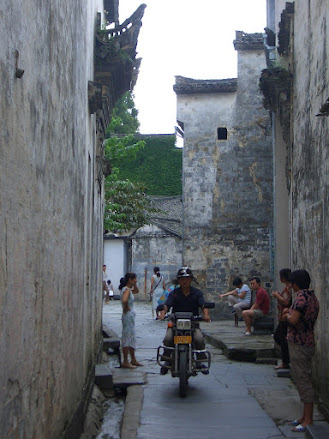
Walking around the time-polished lanes, I couldn’t help thinking: what was it like to live here in the 19th and early 20th centuries when these two villages were among the most prosperous in the land? What was it like to go in and out of these homes, visit one’s neighbors, buy a bucket from an itinerant salesman?


Though I was now a tourist examining what was essentially a heritage showcase, there was still so much to discover and discern. Round a corner and one spies a broom propped against a wall, push open a gate and there is a courtyard with a canopy formed by delicate vines from which fruit are impossibly suspended. 


Glancing through a doorway, I saw a violin lesson in progress. What amazed me was that the mother was actually holding up the music piece for her young protégé. I felt like I was sharing in a cherished album, or witnessing the unscrolling of a fragile painting. Little by little, fleeting insights were thrown in my path, perhaps in jest, perhaps as an earnest invitation to explore further.

I began to understand that the way traditional dwellings were designed and even the manner that they were distributed on the terrain could be read as virtual guides or maps. These helped instruct residents on the gentle art of living.  As one writer has pointed out:  the Chinese residence “is structured to shape family organization and to weave the web of social and ethical norms that linked the household to the world beyond. “


Likewise, these jumbles of alleys and walkways that I was negotiating followed patterns that were honored and repeated all across the realm. Hongcun and Xidi were both sited so that they were embraced by water and buttressed by solid mountains. This is a feng shui specification that one will see even at the Forbidden City in Beijing, countless leagues to the north. As above, so below – such it has been and always will be for the Celestial Empire.

The lay-out of Hongcun itself is said to resemble a cow. Forming the head at one end is a hill with its two tall trees representing horns. The four bridges are the legs while the canals that circulate throughout the town are likened to intestines and veins. At the very center is the Moon Pond of Crouching Tiger fame. This is considered the cow’s stomach.


The bovine metaphor, amusing as it may seem at first, can impart many lessons to the inhabitants. First there is the recognition of humans’ relation to the land. It is our environment – lakes, rivers, mountains, forests  - which gives us our context. Feng shui may seem like superstition to some but at its heart is the realization that we must all engage with the harmony of nature.

Then there is the primacy given to our fellow creatures. Farm animals, especially, are accorded their due respect since without them our own lives would be much reduced. Perceiving that one’s hometown is shaped like a cow (as opposed to an airplane in Brasilia!) is a reminder that we must recognize the roles of other species in our biosphere.


That canals are thought of as intestines and veins stresses the importance of water. We cannot live without water in the same way that we will expire without blood or digested food coursing through our bodies. The capillary comparison is, simultaneously, an admonition not to forget that we are all inter-related. A blockage or a breakdown in one part of the network could wreak havoc in another area. One cannot throw garbage into the canal system as this would affect one’s neighbors who may decide to be as cavalier with you.
Every building in these villages arises from and is enveloped by a fabric of symbols. Doors are flanked by a pair of ornaments in the shape of drums and other objects to announce the main occupation of the family. The number of steps corresponds to established codes of meaning. Vestibules in Southern Anhui always contain a table on which is set a clock and a vase as these are considered auspicious.  There are, as well, lattice screens carved with a design of randomly arranged triangles, a motif known as “cracked ice”. These are meant to help one contemplate the difficulties and complexities of life. A variation has flowers interspersed with the triangles. Perhaps these suggest a reprieve from all that hardship. 
A townscape is effectively a three-dimensional record, a palimpsest of a people’s history. Mud stains may reveal how high the waters had raged in a great flood. Blackened areas grimly commemorate a fire or even war. A battered fence may bring back one’s childhood.


Outside the village of Xidi there is a winding path that passes under several exquisite stone arches. These are memorials to the achievements of certain residents. Usually their accomplishments have to do with hurdling the Imperial Examinations paving the way to an illustrious career in the Civil Service. Sometimes, the arches are erected for filial sons and even for devoted widows.   In this way, individual diaries and family records merge with the archives of a community. Village history is  inscribed on rock so that all may see and in seeing, remember.


Though Xidi and Hongcun had been prosperous villages,  with the reduction of rural populations in the 20th century, the vitality of these traditional communities began to wane. Fortunately the rediscovery of these heritage enclaves has brought new life as engendered by income from the tourist trade.  Many who come have apparently seen the same gracefully choreographed cinematic fight scene as I did. This is evidenced by the great increase in arrivals after the release of Ang Li’s film.

In a way, a formula is taking shape. Centuries ago, once wealthy towns were able to afford elaborate buildings. As the years roll by, a reversal in fortunes ironically ensures that there is no money to tear down these singular structures to set up others according to the tastes of the minute. Matchless edifices are then preserved for the time that they are stumbled upon by the historically inclined. Once these pockets of the past become well-known, hordes of travelers begin to descend. Everyone is hoping for an encounter with origins as couched in the comforts of the internet, fastfood and a spa or two. One notes this tale repeated all over: Anhui, Hoi An, Pingyao, Lijiang, and even our very own Vigan.


The danger is that heritage towns become parodies of themselves all in the name of tourism. As the sociologist John Urry has warned in his tome, The Tourist Gaze, travelers have a way of rendering all that they see as consumer products. Crafts become souvenirs, residents become quaint natives, sacred rituals become spectacles. One way to counter this homogenizing vision is to celebrate the uniqueness of every place as developed by the aspirations of the people who live there.

Certainly, many have complained about the commercialization of Hongcun and Xidi. At the other side of these complaints, however, is the question: if it were not for the travel industry, how else would the villagers survive?


I suppose that the challenge is finding a balance between creating livelihood opportunities and maintaining the integrity of traditional environments. It has to do with understanding that the real attraction of a place is the vibrancy of its own community life.  It has to do with realizing that what makes our dwelling places flourish is the rootedness in the fertile soil of meanings, symbols, and ways of knowing. These have always provided sustenance and consolation in a shifting and shifty world.
Perceiving the nuances in the vast wealth of messages provided by the fascinating albums, guiding maps, patchwork cloaks, and palimpsests that are the villages of Anhui may just be the beginning. But it is a good place to start.


The writer would like to thank Carlos and Carlson Chan of Liwayway/Oishi Corporation for their patience and hospitality.